
ETF Spotlight: DIVO—The Active Alternative in a "Mechanical" Market

In the "income arms race" of 2026, the covered call ETF has become the retail investor's favorite weapon. But not all weapons are built for the same purpose. While the market is currently flooded with mechanical, index-tracking funds that prioritize max yield, DIVO (Amplify CWP Enhanced Dividend Income ETF) continues to stand out for what it doesn’t do.
As of late April 2026, DIVO has carved out a unique reputation: it is the "Quality-First" fund for retirees who want 5–7% yields but refuse to give up their long-term capital appreciation.
The DIVO DNA: Tactical vs. Mechanical
To understand DIVO, you have to look at the competition. Most popular covered call ETFs follow a "mechanical" ruleset: they sell calls on 100% of the index at set intervals, regardless of whether it’s a good time to sell.
DIVO operates on a Tactical Strategy:
- Selective Portfolio: It holds a concentrated group of roughly 20–25 high-quality, dividend-growing stocks (like Microsoft, Goldman Sachs, and Caterpillar).
- Tactical Overlays: It only writes covered calls on individual stocks when the managers see high volatility. It typically only covers a portion of the portfolio (2–4% yield target from options), leaving the rest open to capture growth.
DIVO vs. The Giants: How It Differs
If you are weighing DIVO against other heavy hitters like JEPI, JEPQ, or XYLD, the differences come down to "Upside" and "Structure."
| Feature | DIVO | JEPI / JEPQ | XYLD / QYLD |
| Option Target | 20–30% of portfolio | Uses ELNs (Notes) | 100% of index |
| Portfolio | Active Stock Picking | Low-Vol / Tech Focus | Index Tracker |
| Yield Style | Tactical & Conservative | Quantitative | Mechanical & High |
| Upside Cap | Low (More growth) | Moderate | High (Capped) |
| Expense Ratio | 0.56% | 0.35% | 0.60% |
The Key Takeaway: JEPI and JEPQ use Equity-Linked Notes (ELNs) to generate income, which introduces counterparty risk. DIVO writes "old fashioned" covered calls on the actual stocks it owns, making its structure more transparent.
The Case for DIVO: Benefits & Risks
The Benefits
- Total Return Focus: Because it doesn't cap the whole index, DIVO has historically outperformed 100% covered call funds during strong bull markets.
- Dividends Over Yield: It focuses on companies that actually grow their cash flow, providing an inflation hedge that mechanical funds often lack.
- Volatility Buffer: The option income provides a "cushion" that has helped DIVO outperform the S&P 500 in flat or slightly down years like 2022 and early 2026.
The Risks
- Active Management Risk: You are betting on the manager’s ability to pick the right stocks and the right time to write calls. If they miss a rally in tech, the fund will lag.
- Concentration: With only ~25 holdings, a bad quarter for one or two "Giant Cap" names (like Apple or Microsoft) has a much larger impact than in a 500-stock index.
- Tax Efficiency: While the dividends are largely "Qualified," the option income is taxed as Ordinary Income, which can be a drag for those in high tax brackets.
The Cash Flow Dossier: Distribution History
Retirees don't just want yield; they want predictability. DIVO’s payout history reflects its "Total Return" mandate. While it doesn't offer the 10-12% headline yields seen in more aggressive funds, its "Base Dividend" is supported by actual corporate earnings.
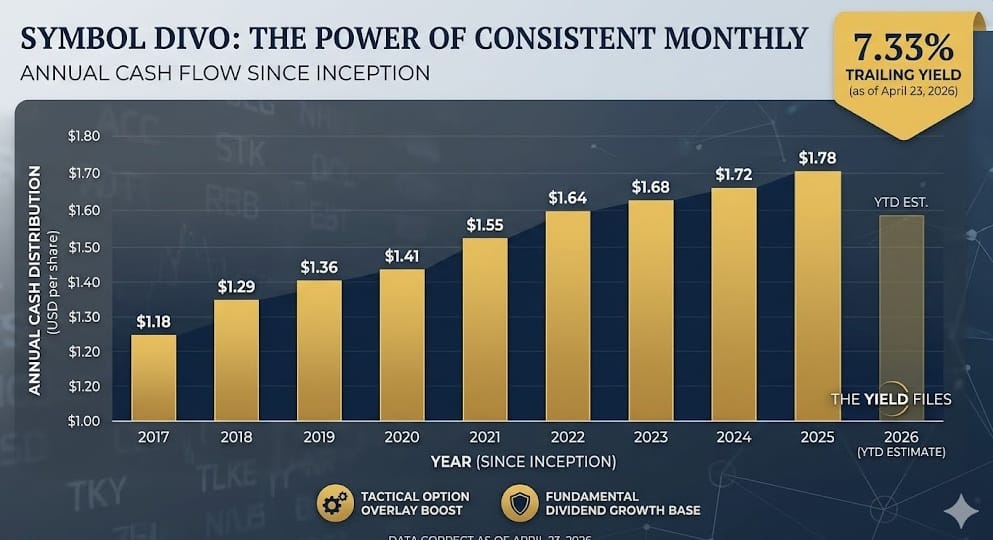
Note: 2025 included a significant year-end capital gain distribution, which is common for active funds that harvest wins.
The Bottom Line
In 2026, DIVO is the thinking man’s income fund. It’s built for the investor who wants to "sip" their income rather than "gulp" it. If you’re looking for a core equity holding that pays a monthly check without cannibalizing your principal, DIVO remains a top-tier candidate for the Alpha Bucket.