Junk Bond Jigsaw: Yields are High, but Safety is Thin
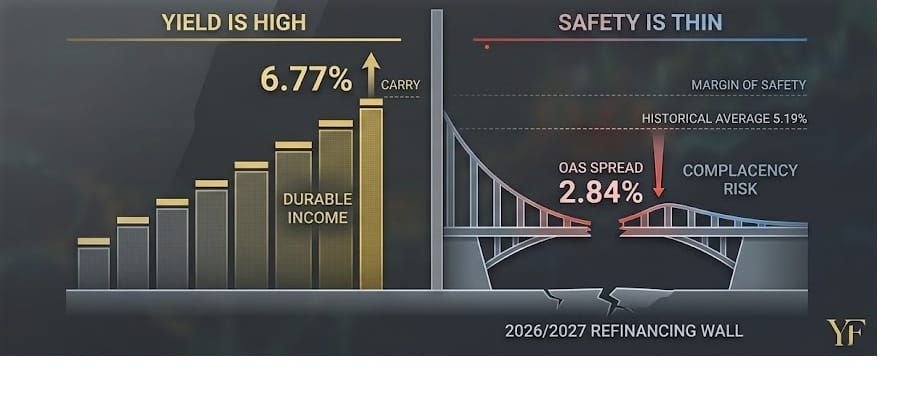
As of April 23, 2026, high-yield corporate bonds are yielding approximately 6.77%. On the surface, this looks attractive for an income-starved retiree. However, the Option-Adjusted Spread (OAS)—the yield gap between these bonds and "risk-free" Treasuries—is currently sitting at 2.84%.
To put that in perspective, the long-term average spread is closer to 5.19%. In plain English: investors are currently accepting nearly half the historical compensation for taking on the risk of corporate default.
The Opportunity: The "Carry" is Still King
Despite the tight spreads, the high-yield market isn't a "no-go" zone. There are two primary reasons why capital continues to flow into this space:
- Durable Income: In a "higher-for-longer" interest rate environment, the 6.7%+ yield provides a massive "carry" advantage. Even if bond prices fluctuate, the monthly interest payments are large enough to offset minor price drops.
- Solid Fundamentals (For Now): Many high-yield issuers entered 2026 with healthy balance sheets. Default rates are currently hovering in a manageable range of 1.5% to 3%, meaning the "junk" isn't as trashy as it was during the 2008 or 2020 crises.
The Risks: The 2026 Refinancing Wall
The biggest threat to this market isn't the current yield—it's the Maturity Wall. Between 2026 and 2027, hundreds of billions in corporate debt issued during the "zero-rate" era (2020-2021) is coming due.
- The Sticker Shock: Companies that were paying 3% or 4% interest on their debt are now being forced to refinance at 7% or 8%. For a company with tight profit margins, doubling their interest expense can turn a "survivor" into a "defaulter" overnight.
- The "Passive" Trap: This is where the risk lies for the average investor. If you own a broad, passive high-yield ETF, you own the entire index—including the companies that are about to hit this wall and crumble.
How to Position: Active Over Passive
In 2026, the high-yield market is a "credit picker's" game. The goal isn't just to find the highest yield; it's to avoid the companies that can't afford their new, higher interest rates.
- The Quality Play (ETF): iShares 0-5 Year High Yield Corporate Bond ETF (SHYG) By focusing on shorter-term bonds, you reduce your "duration risk" (the risk that rising rates will hurt bond prices). It currently offers a robust yield with a focus on bonds that are closer to their maturity, giving you more visibility into the company's ability to pay.
- The Diversified Route (ETF): SPDR Bloomberg High Yield Bond ETF (JNK) This is the "standard" high-yield play. It’s highly liquid and gives you broad exposure. However, in this environment, it should be treated as a tactical tool, not a "buy and hold forever" asset.
- The Active Alpha: BlackRock High Yield Bond Fund (BHOIX) Because spreads are so tight (2.84%), you want an active manager who can look at individual balance sheets and say "No" to the companies nearing the refinancing wall. An active mutual fund or ETF can pivot away from the losers that a passive index is forced to hold.
The Bottom Line
High-yield bonds in 2026 are for investors who prioritize income over capital gains. The 6.77% yield is real, but the "safety margin" is thin. Stick to active management and shorter durations to ensure that your "yield" doesn't turn into a "default" as companies begin to hit the 2026 refinancing wall.